
The vocabulary of domain names is small but confusing, mostly because three of its most important words begin with "regist". Here they all are, in alphabetical order.
- Abuse contact
- The email address or phone number a registrar must publish for reports of phishing, fraud, malware and spam involving its customers' domains. It appears in the WHOIS record.
- ccTLD
- Country code top-level domain: a two-letter extension assigned to a country or territory, such as .uk, .de, .ca or .jp. Each is run under its own national rules.
- Certificate
- A small file that lets a website prove it is entitled to answer for its domain and set up an encrypted HTTPS connection. See what the padlock really means.
- Creation date
- The day a domain was registered. Recorded by the registry and impossible for the owner to alter, which makes it the most reliable fact in a record. See domain age.
- DNS
- Domain Name System: the worldwide directory that turns a name such as example.com into the numeric address of the server that hosts it.
- DNSSEC
- An extension of DNS that signs its answers cryptographically so that they cannot be forged on the way. Optional, and still absent from most domains.
- Domain name
- The registered name of a website, made of a chosen name and an extension: example.com. It is rented from a registry, through a registrar, for one or more years.
- Drop catching
- Registering an expired domain in the instant it is released, using automated tools. See what happens when a domain expires.
- EPP
- Extensible Provisioning Protocol: the language registrars use to send orders to registries. The status codes in a record come from it.
- Expiry date
- The day the paid registration period ends. The domain is not released on that day: several grace stages follow.
- gTLD
- Generic top-level domain: an extension not tied to a country, such as .com, .org, .net, .info or the newer .shop and .app. All follow rules set by ICANN.
- Homograph
- A domain that looks identical to another because it uses lookalike letters from a different alphabet. See how to read a link.
- HTTPS
- The encrypted version of the protocol browsers use to load pages. It protects the connection and proves nothing about the honesty of the site.
- IANA
- Internet Assigned Numbers Authority: the body that maintains the list of all extensions and of who runs each one. Its root zone database is public.
- ICANN
- Internet Corporation for Assigned Names and Numbers: the non-profit organisation that coordinates the domain name system and sets the contracts for generic extensions and their registrars.
- IDN
- Internationalised domain name: a name containing characters outside the basic Latin alphabet. Stored in an encoded form beginning with xn--.
- IP address
- The numeric address of a machine on the internet. A lookup of an IP address identifies the hosting company, not the owner of the website.
- Name server
- A DNS server that holds the technical settings of a domain: where its website and its email are hosted. A record lists at least two.
- Parked domain
- A registered name with no real website, showing adverts or a "for sale" notice.
- Privacy or proxy service
- A company whose details appear in a record in place of the real owner's. See why WHOIS owner details are hidden.
- RDAP
- Registration Data Access Protocol: the modern replacement for WHOIS, using HTTPS and structured data. See WHOIS vs RDAP.
- Redemption period
- The 30 days after an expired generic domain is deleted, during which only its former owner can restore it, for a fee.
- Registrant
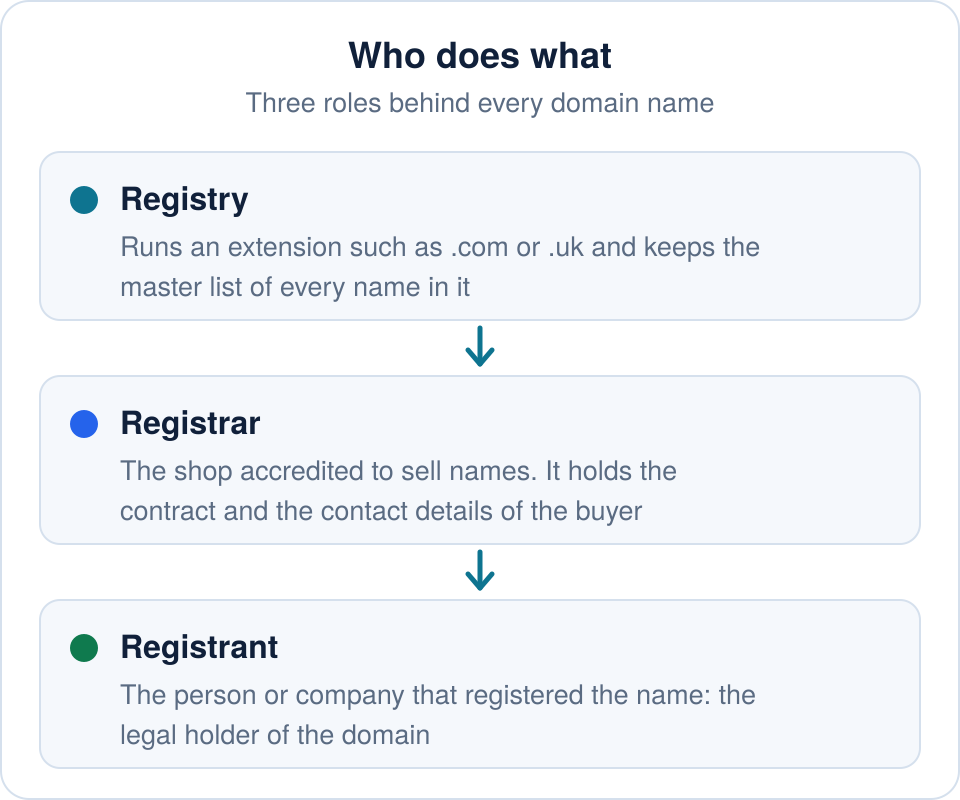
- The person or organisation that registered a domain: its legal holder, in everyday language its owner.
- Registrar
- A company accredited to sell domain names to the public and to manage them with the registries. The registrar holds the contract with the registrant.
- Registry
- The organisation that runs an extension and keeps the authoritative list of every name in it. Verisign is the registry of .com, Nominet of .uk.
- Registry lock
- An extra protection in which the registry itself refuses any change to a domain without manual verification. Used for high-value names.
- Reseller
- A company that sells domains through a registrar without being accredited itself. Many web hosts are resellers. The record names the registrar behind them.
- Subdomain
- Anything written to the left of a domain name, separated by a dot: shop.example.com. Created freely by the owner of the domain, with no registration.
- TLD
- Top-level domain: the last part of a domain name, after the final dot. Also called the extension.
- Transfer
- Moving a domain from one registrar to another. It requires unlocking the domain and an authorisation code supplied by the current registrar.
- Typosquatting
- Registering misspellings of a well-known name to catch people who mistype it or do not look closely.
- UDRP
- Uniform Domain-Name Dispute-Resolution Policy: the arbitration procedure through which a trademark holder can recover a domain registered in bad faith.
- WHOIS
- Both the public registration record of a domain and the protocol historically used to read it. See what is a WHOIS record?