
WHOIS is more than forty years old and is being retired. Its replacement, RDAP, carries the same information in a modern form. If you only want to look up a domain, nothing changes for you. Here is what changed behind the scenes.
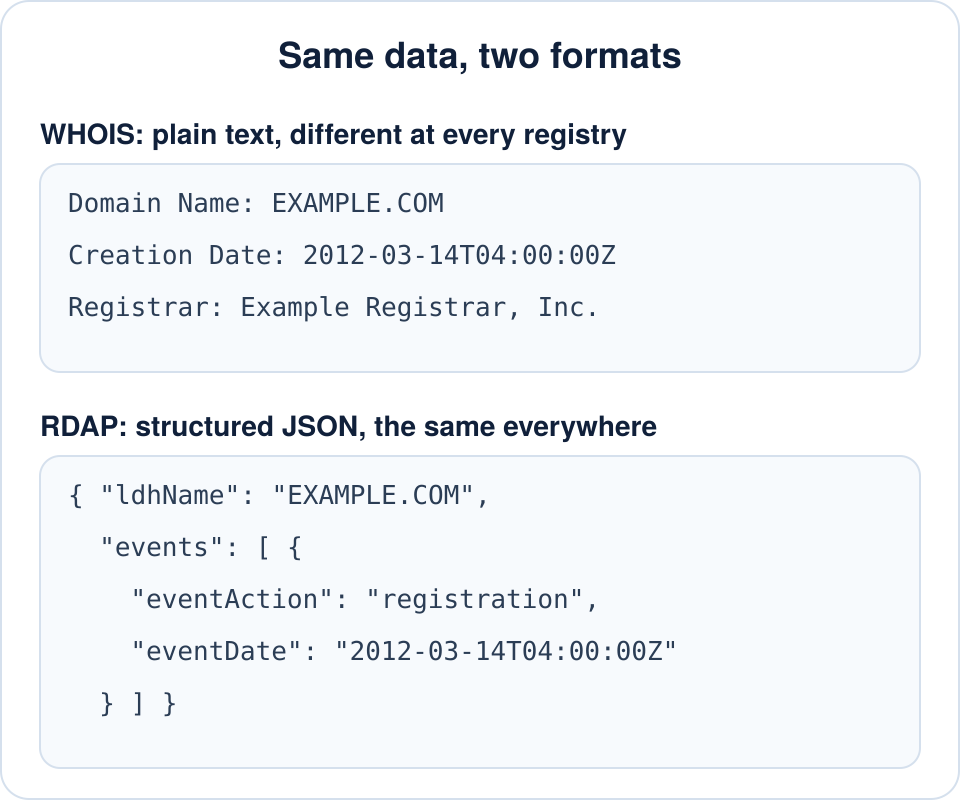
What was wrong with WHOIS
The WHOIS protocol is almost comically simple: open a connection on port 43, send a name, receive text. The current specification, RFC 3912, fits on a few pages. That simplicity kept it alive for decades and also explains its problems.
- No standard format. The protocol does not say what the answer should look like. Every registry invented its own labels, date formats and layout, so software has to recognise hundreds of variants.
- No encryption. Queries and answers travel in clear text.
- English letters only, in practice. There is no agreed way to send names and addresses in other scripts.
- No way to find the right server. Nothing in the protocol says which server knows about which extension. Tools rely on lists and on following referrals.
- All or nothing. A server cannot show more to a verified police officer than to an anonymous visitor. When privacy law arrived, the only option was to hide data from everybody.
What RDAP is
RDAP stands for Registration Data Access Protocol. It was standardised by the Internet Engineering Task Force in 2015 and answers each of those problems.
- It runs over HTTPS, like a website, so it is encrypted and passes through ordinary networks.
- Answers are JSON, a structured format every programming language reads, with field names fixed by the standard (RFC 9083).
- It supports every script.
- A public file maintained by IANA says which server to ask for each extension.
- It allows differentiated access: the same server can return the public record to most people and more to an authorised requester.
What happened in January 2025
Registries and registrars of generic extensions have had to offer RDAP since 2019. On 28 January 2025 the other half of the change took effect: their contractual obligation to run a WHOIS service ended, and ICANN declared RDAP the definitive source of registration data for those extensions. ICANN's own announcement describes it as the sunset of WHOIS.
Sunset does not mean switched off everywhere. Many registries still answer on port 43 because their customers' tools expect it. Others have closed the service, and more will follow. Country code extensions are not bound by ICANN contracts and decide for themselves: a growing number offer RDAP, some offer only WHOIS, some offer neither to the public.
Side by side
| WHOIS | RDAP | |
|---|---|---|
| First specified | 1982 | 2015 |
| Transport | Plain text on port 43 | HTTPS |
| Answer format | Free text, different everywhere | Standard JSON |
| Encryption | None | Yes |
| Non-Latin scripts | Unreliable | Supported |
| Finding the server | Lists and referrals | Official bootstrap file |
| Different access levels | No | Possible |
| Required for generic extensions | No longer, since January 2025 | Yes |
Is the information different?
No. Both protocols read the same database at the registry. The dates, the registrar, the status codes and the name servers are identical, and so are the privacy rules: what is redacted in WHOIS is redacted in RDAP. RDAP has a few extras, such as a clear list of events with their dates and a standard way of saying that a field was deliberately withheld.
The word itself is not going away either. "WHOIS" has become the everyday name for looking up a domain, whatever protocol does the work, in the same way people still "dial" a number.
What CheckWhois does
A lookup uses whichever service the registry of that extension provides. Where a WHOIS server answers, the record is shown as the registry wrote it. Where only RDAP is available, the answer is fetched over HTTPS and laid out in the familiar line by line form, so the report reads the same either way. The report names the servers that answered.
You can also query RDAP directly with ICANN's own lookup tool, which shows the raw data for generic extensions without any score.
Does this change anything for spotting scams?
Not really. The facts that matter, above all the creation date, are the same in both. If anything, structured data makes automated checks more reliable, because a date is a date and no longer a line of text to be guessed at.