
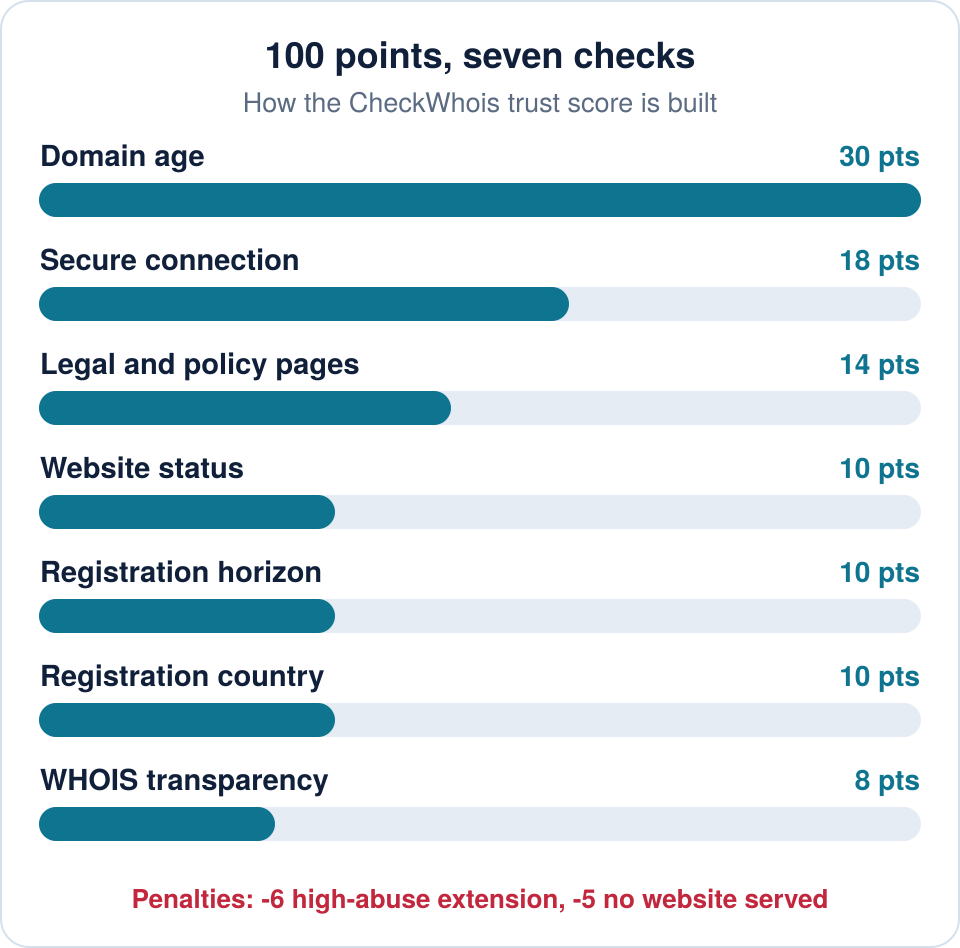
CheckWhois turns the registration record of a domain, plus a few live tests on the website itself, into a score out of 100. Nothing is hidden: this page lists every criterion, every threshold and the number of points each one earns.
1. Domain age: 30 points
The strongest signal there is. Fraudulent sites are overwhelmingly built on names registered a few days or weeks earlier, used for one campaign and abandoned. A domain that has existed for ten years has outlived thousands of them.
| Age of the domain | Points |
|---|---|
| 10 years or more | 30 |
| 5 to 10 years | 27 |
| 3 to 5 years | 23 |
| 2 to 3 years | 19 |
| 1 to 2 years | 14 |
| 6 to 12 months | 9 |
| 3 to 6 months | 5 |
| 1 to 3 months | 2 |
| Under 30 days | 0 |
| Creation date not published | 6 |
More on this criterion in how to check the age of a domain.
2. Secure connection: 18 points
The site is contacted over HTTPS and its certificate is verified. A valid certificate earns the full 18 points. HTTPS with a certificate that cannot be verified (expired, self-signed, issued for another name) earns 7. No encryption at all earns nothing. HTTPS is necessary but far from sufficient, as explained in what the padlock really means.
3. Legal and policy pages: 14 points
CheckWhois looks for terms, a privacy policy, a legal notice, an about page and a contact page at the addresses where websites usually publish them. Three or more pages found earn 14 points, one or two earn 8, none earns 0. A real business has to publish this information; a disposable storefront rarely bothers. The check only confirms that the pages exist, not that what they say is true.
4. Website status: 10 points
A site that answers normally earns 10 points. A site that answers with a redirect or another non-error response earns 7, a server error earns 2, and a domain with no working website earns 0.
5. Registration horizon: 10 points
How far ahead the domain is paid for. Someone who has paid several years in advance is not planning to vanish next month.
| Time left before expiry | Points |
|---|---|
| More than 2 years | 10 |
| 1 to 2 years | 8 |
| 6 to 12 months | 5 |
| 3 to 6 months | 3 |
| Under 3 months, or already expired | 0 |
| Expiry date not published | 4 |
This is a weak signal on its own: plenty of serious sites renew one year at a time. See what happens when a domain expires.
6. Registration country: 10 points
When the record publishes the country of the registrant, most countries earn the full 10 points. A short list of jurisdictions with the highest reported rates of domain abuse earns 3. When no country is published, the score is 6. This is a statistical signal and nothing more: it says nothing about a country or the people who live there, and it weighs a tenth of the total for that reason.
7. WHOIS transparency: 8 points
A record that names an owner earns 8 points. A record hidden behind a privacy service or redacted under data protection law earns 4, and a record with no owner information at all earns 3. The gap is deliberately small, because hidden owner details are now the norm, including for perfectly honest sites.
The two penalties
High-abuse extension: 6 points off. A few extensions are massively over-represented in abuse reports, often because names in them are free or nearly free: .tk, .ml, .cf, .buzz and a handful of others.
No website served: 5 points off. A domain that resolves to a server which answers nothing is a common pattern for parked names and abandoned scam sites.
The total is then kept between 0 and 100.
How to read the result
| Score | Label | What it means |
|---|---|---|
| 80 to 100 | High trust | An established domain with nothing unusual in its record. |
| 60 to 79 | Good | Solid overall, with one or two weaker points. |
| 40 to 59 | Mixed signals | Look at which criteria lost points before deciding. |
| 20 to 39 | Low trust | Several warning signs at once. Be careful. |
| 0 to 19 | Very low trust | Almost everything is missing or brand new. |
Is a trust score reliable?
Not on its own, and it would be dishonest to pretend otherwise. Two failure modes are worth keeping in mind.
- A new site is not a scam site. An honest business that launched last month will score badly on age, horizon and policy pages all at once. Low score, legitimate shop. Treat it as a reason to be careful, not a reason to walk away.
- A high score can be bought. Organised fraudsters buy expired domains precisely because they come with history, add a free certificate and copy a privacy policy in five minutes.
The score measures the domain, not the business. It cannot read reviews, test a product or check that a company exists. It is a fast first filter, and these habits are what catch the rest.