
A domain name is rented, not bought. When the rent is not paid the name does not vanish overnight: it passes through several stages, each with its own rules, before anyone else can register it.
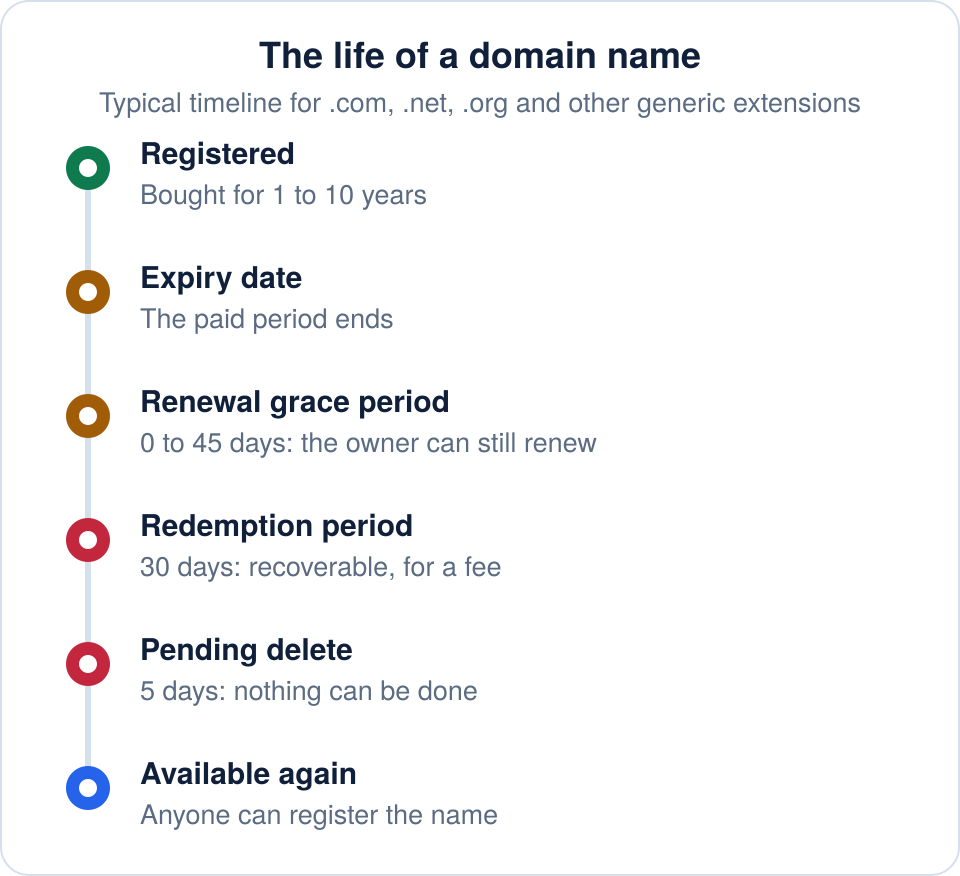
The paid period
A domain is registered for a whole number of years, from one to ten for generic extensions such as .com, .net and .org. The end of that period is the Registry Expiry Date in the WHOIS record. Renewing adds years to the existing date, so renewing early costs nothing in lost time.
Registrars are required to remind the owner before the date, at least twice, by email to the address on file. The commonest reason a domain is lost is not forgetfulness but an old email address that nobody reads any more.
Stage 1: the renewal grace period
The day after expiry, most registries automatically extend the registration by a year and give the registrar up to 45 days to confirm or cancel. During this time the record often shows an expiry date a year in the future and the status autoRenewPeriod, which looks reassuring and is not: nothing has been paid.
What the owner experiences depends on the registrar. Usually the website and email stop working within days and are replaced by a parking page saying the domain has expired. The owner can still renew at the normal price. How long this lasts is the registrar's decision, anywhere from a few days to the full 45, so the registrar's own terms are the only reliable source.
Stage 2: the redemption period
If the domain is not renewed, the registrar deletes it and the registry places it in redemption, status redemptionPeriod, for 30 days. The name no longer works at all. The original owner, and nobody else, can still get it back through the registrar, but restoring costs a penalty fee on top of the renewal, commonly several times the yearly price.
Stage 3: pending delete
After redemption the domain enters pendingDelete for 5 days. Nothing can be done during this stage: no renewal, no restore, no transfer. It is a countdown.
Stage 4: release
At the end of pending delete the registry removes the name and it becomes available to the first person who asks for it. For any name with value, that person is a machine. Specialised companies watch the lists of names about to be released and send registration requests in the same second the name drops, a practice known as drop catching. A name that had visitors or links is very unlikely to wait for a human to notice it.
In total, roughly 35 to 80 days pass between the expiry date and the release, depending on how much of the grace period the registrar allows.
Country extensions are different
Everything above describes generic extensions governed by ICANN rules. Country code extensions such as .uk, .de, .fr or .au are run under national rules and each has its own timetable: some have no redemption period at all, others suspend the name for a fixed number of days and then release it. If your domain is under a country extension, check the registry's own documentation.
What the expiry date tells you about a website
When you look a site up, the expiry date gives a hint about the owner's intentions.
- Several years ahead. Someone has paid in advance and expects to be there. It is a mild positive sign, worth up to 10 points in the trust score.
- Less than a year ahead. The most common situation, since many owners renew annually. It means nothing by itself.
- A few weeks ahead on a domain created less than a year ago. The domain was bought for the minimum period and has not been renewed. Combined with other warnings, it fits the pattern of a site not meant to last.
- In the past. The site is living on its grace period and may go offline at any moment. Do not order from it.
Expired domains and second lives
Released names do not always go back to honest use. A domain that belonged to a business, a charity or a local newspaper keeps its reputation for a while: links from other sites, a place in search results, trust from spam filters. That makes it attractive to people who want to look established without waiting. The new site may have nothing to do with the old one.
When the name was fully released and registered again, the creation date in the record starts over, which gives the change away. When it was bought at auction before deletion, the old date remains. In both cases, content that does not match the name is the clue.
If it is your own domain
- Turn on automatic renewal and keep a valid payment method on the account.
- Make sure the contact email at your registrar is one you read, and not an address on the domain itself, which stops working when the domain does.
- Renew important names for several years at once.
- If the name has already expired, contact the registrar at once. The earlier the stage, the cheaper the recovery.