
How long a website has existed is the hardest thing for a fraudster to fake and the easiest thing for you to check. The answer is in one line of the WHOIS record.
Where to find the age
Run a lookup and read the line Created on, or Creation Date in the raw record. That date is recorded by the registry at the moment of registration. The owner cannot edit it, a web designer cannot backdate it, and it does not depend on anything written on the site.
Compare it with what the site says about itself. "Family business since 1998" on a domain created in the spring is not automatically a lie, since a company can be older than its website, but it is a question the seller should be able to answer.
Why age is such a strong signal
A fraudulent shop has a short life by design. It is reported, blocked by browsers and payment providers, and suspended by its registrar, usually within weeks. Its operators know this, so they register names in bulk, use each one for a single campaign and move on. The result is that the population of scam sites is, at any given moment, overwhelmingly made of very young domains.
An honest business behaves in the opposite way. It keeps the same address for years, because the address is the business: customers, search engines and printed material all point to it.
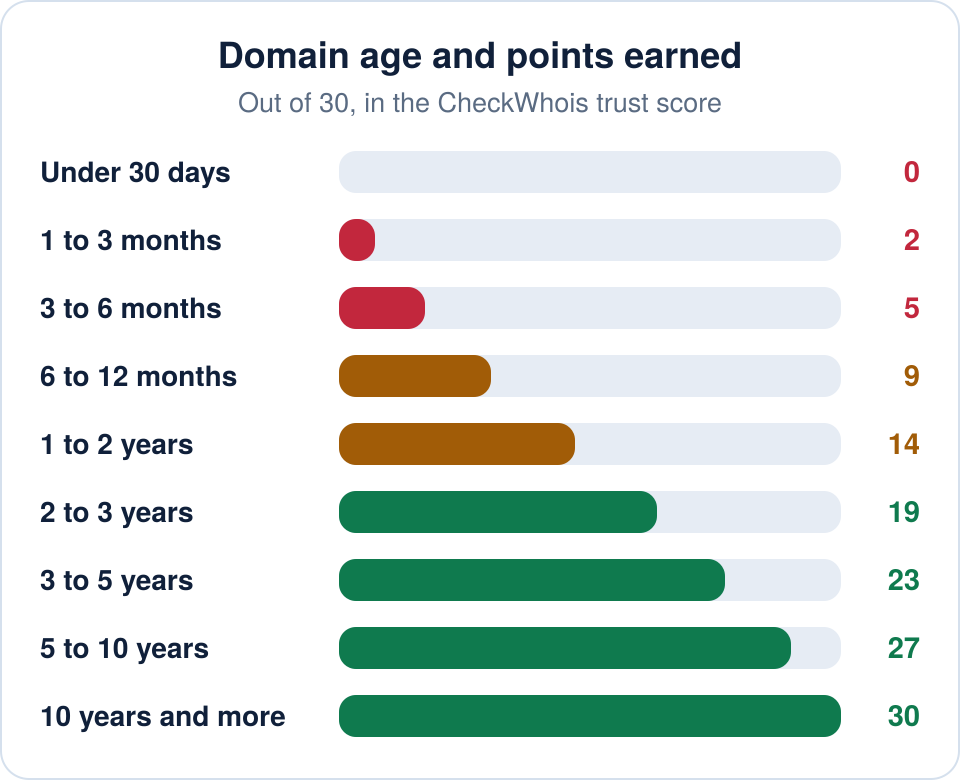
That asymmetry is why domain age weighs 30 points out of 100 in the CheckWhois trust score, more than any other criterion.
How to read the number
- Under one month. Not proof of anything, but treat the site as unknown. Do not pay by a method you cannot reverse.
- One to six months. Still young. Look for a company you can identify and reviews on sites the seller does not control.
- Six months to two years. Most throwaway sites do not live this long. The other signals now matter more than the age.
- More than two years. The domain has survived several rounds of reports and renewals. Age is no longer a concern, which is not the same as the site being safe.
Three cases where age misleads
The honest newcomer
Every legitimate business was new once. A shop that opened last month has a young domain, a short registration period and perhaps unfinished legal pages, and it will score badly for all of them at once. A low age is a reason to pay carefully, not a reason to accuse.
The recycled domain
When a domain is not renewed it is eventually released, and anyone can register it again. Names with history are sought after precisely because they look established: they may still have links pointing to them and a good reputation with search engines and spam filters. There are two variants. If the name was fully deleted and registered again, the creation date starts over and the record tells the truth. If it was bought before deletion, at auction or directly from the previous owner, the old creation date stays although everything else has changed.
The clue is a mismatch between the age and the content: a fifteen year old domain whose name suggests a village football club and whose pages now sell discounted sunglasses. A web archive such as the Wayback Machine will show what the address used to be.
The missing date
A few country registries do not publish creation dates, and some records are returned incomplete. When the date is absent, CheckWhois gives a neutral 6 points out of 30 rather than guessing, and says so in the report.
Age of the domain, age of the business
These are different things, and both matter. The domain age comes from the registry. The age of the business comes from a company register, which is also public and free in most countries. A domain can be older than the company that now owns it, and a company can be much older than its domain. When the two tell a coherent story, that is reassuring. When the site claims decades and neither the registry nor the company register agrees, believe the registers.
In practice
Before a first purchase from an unfamiliar site, check the creation date. If the domain is less than a few months old, slow down: look for the seller's identity, check the usual signs of a fake shop and pay with a card rather than a transfer. It takes less time than reading this page did.