
A fake shop takes your payment and sends nothing, or sends a worthless imitation. It usually looks excellent, because the design was copied from a real one. The giveaways are elsewhere.
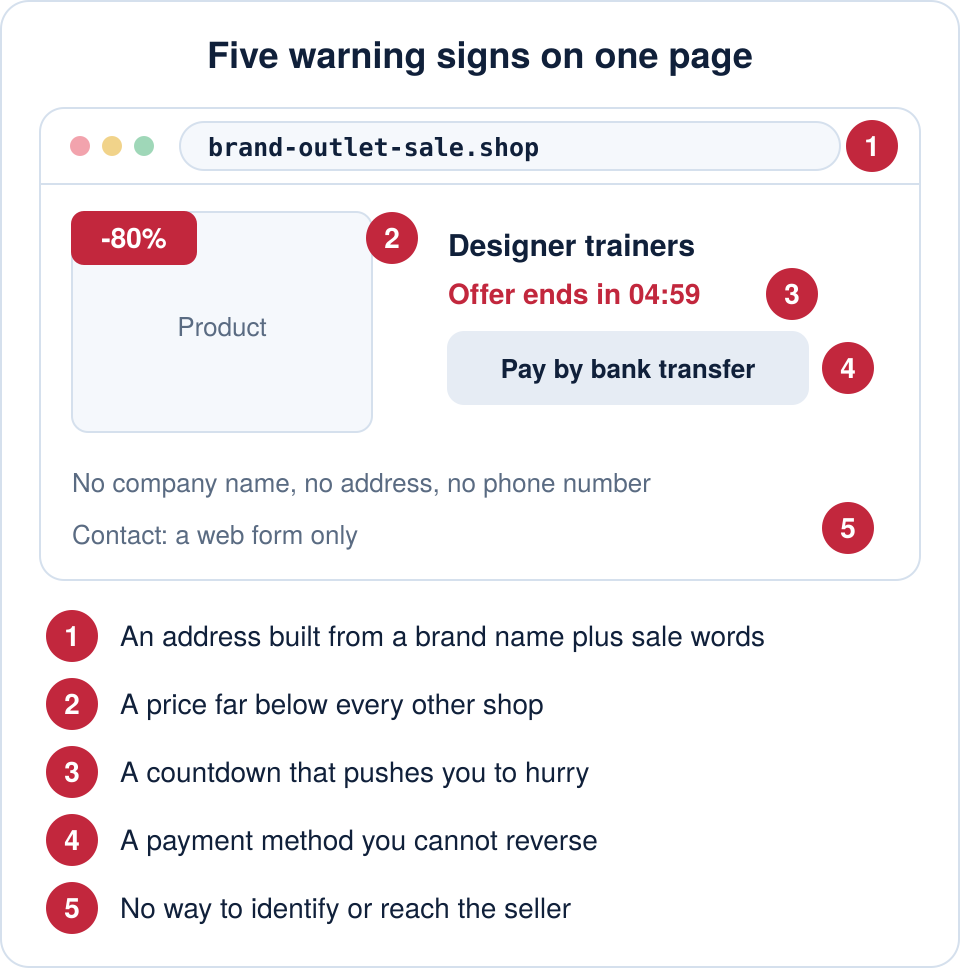
1. The address is almost a brand
Fake shops rarely use a random name. They take a known brand and add words: outlet, sale, official, store, clearance, a country, a year. The extension is often an unusual one. The real brand sells on its own domain, the one you can find on the label of something you already own.
2. The domain is very young
The fastest check there is. A WHOIS lookup shows the creation date of the domain, and no page design can change it. A shop offering a clearance sale on a domain registered three weeks ago has not had time to accumulate stock to clear. See how to read the age of a domain.
3. The prices are too good
Seventy or eighty percent off everything, all sizes available, on products that never go on sale elsewhere. Real discounts are uneven: some items, some sizes, end of season. A uniform, enormous discount is a sign that the prices were never meant to be honoured.
4. You are being hurried
A countdown that restarts when you reload the page, a banner announcing that twelve people are looking at this item, stock that is always "2 left". The purpose of urgency is to stop you doing what you are doing right now.
5. Nobody is behind it
Look for a company name, a registered address and a company number, normally in the footer or on a Terms or Legal page. A real shop has them because the law requires it in most countries. If there is a company name, check it in the public company register: fake shops sometimes borrow the identity of a real, unrelated business.
6. The only contact is a form
No phone number, no postal address, an email at a free webmail provider, or a form and nothing else. Write to them before ordering if you are unsure. A real shop answers; a fake one rarely bothers.
7. The legal pages are borrowed
Returns and privacy pages copied from another site are common. Read a paragraph. You may find the name of a different shop left in the text, a returns address in a country the shop never mentions, or sentences that plainly went through an automatic translator.
8. The payment method cannot be reversed
This is the most important sign, because it is the one that costs you money. Logos of every card and payment service are displayed, then at the last step only a bank transfer, a cryptocurrency or a gift card code is accepted, often with an excuse about a technical problem. Stop there. No discount is worth a payment you cannot dispute.
9. The reviews are all on the shop itself
Five stars everywhere, short, undated, with first names only. Search for the shop's name together with the word "scam" or "reviews", and look at independent review sites. No trace of the shop anywhere is as telling as bad reviews: an established shop leaves marks.
10. The social media links go nowhere
Icons in the footer that link to the home pages of the social networks rather than to an account, or to an account created last month with purchased followers. Many fake shops are advertised through sponsored posts: an advert on a social network is not an endorsement by that network.
Signs that prove nothing
- The padlock. Every fake shop has HTTPS. See what the padlock really means.
- Trust badges. Pictures of security seals are just pictures. A real seal links to a verification page on the certifier's own site.
- A professional design. Templates and copied sites cost nothing.
- Appearing in search results or adverts. Paid placements can be bought by anyone for a few days.
The two minute check
- Read the address slowly. Is it the brand's own domain?
- Look the domain up. How old is it?
- Find the company name and address. Do they exist?
- Search the shop's name with the word "reviews".
- At checkout, confirm you can pay by card or with buyer protection.
If any one of these fails badly, buy elsewhere. If you have already paid, act quickly: here is the order of steps.