
It happens to careful people. What you do in the first hours matters more than anything else, so here are the steps in the order to take them.
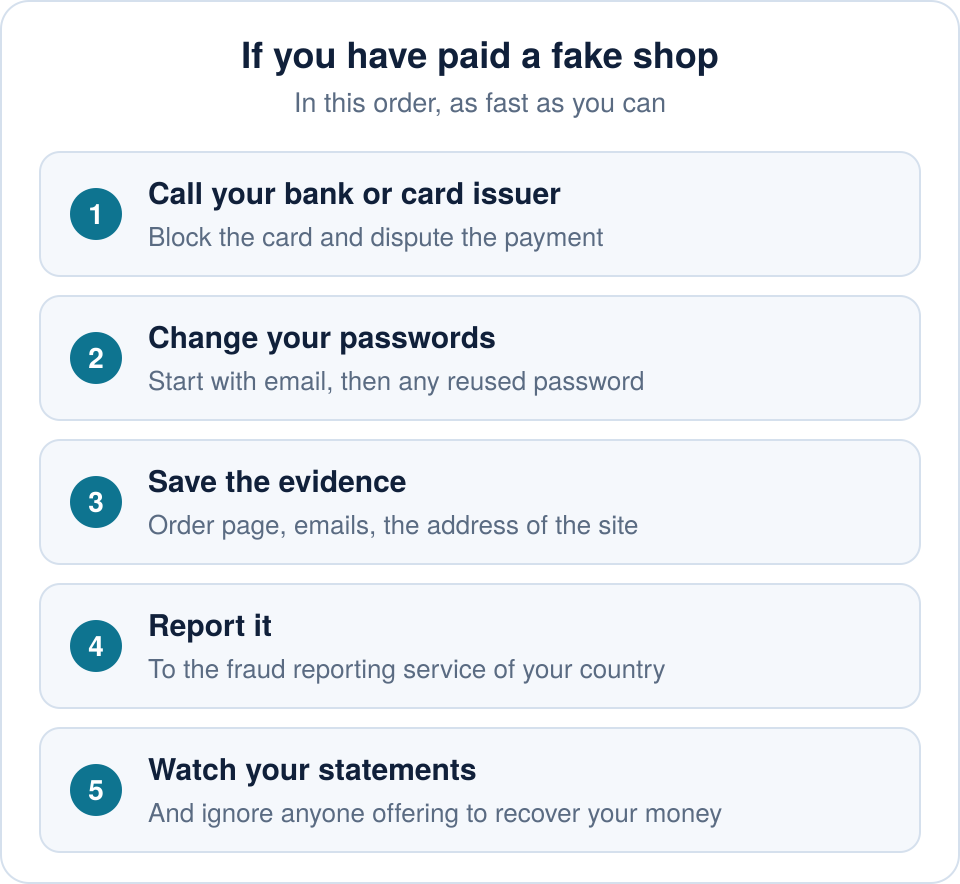
1. Contact your bank or card issuer now
Do this before anything else, by phone, using the number on the back of your card or in your banking app. Say that you have paid a fraudulent merchant and want to dispute the payment.
- Card payment. Ask for a chargeback. Card schemes allow disputes for goods not received or not as described, within a limited period that is often around 120 days, but do not wait. If you entered your card details on a suspicious site, ask for the card to be blocked and replaced: the details may be reused.
- Credit card, United Kingdom. For purchases between 100 and 30,000 pounds, Section 75 of the Consumer Credit Act makes the card provider jointly liable with the seller.
- Credit card, United States. The Fair Credit Billing Act lets you dispute a charge in writing within 60 days of the statement that shows it.
- Payment service with buyer protection. Open a dispute in the service itself, within its deadline.
- Bank transfer. Call immediately. A transfer can sometimes be recalled if the receiving bank is alerted before the money is moved on, and some countries have reimbursement schemes for this kind of fraud. Hours count.
- Cryptocurrency or gift cards. These are almost never recoverable. Report it anyway, and tell the gift card issuer: unspent cards can sometimes be frozen.
2. Secure your accounts
If you created an account on the fake site, the password you used there is now known to criminals. Change it everywhere you used the same one, starting with your email, because whoever controls your inbox can reset all your other passwords. Use a different, generated password for each site from now on, and turn on two-step verification.
If you were persuaded to install software, or to let someone take remote control of your computer or phone, treat the device as compromised: disconnect it, have it checked, and change your passwords from another device.
3. Keep the evidence
Before the site disappears, save what you can: screenshots of the product page and the order confirmation, the full address of the site, every email and message, the payment receipt and the name and account number of the recipient if you paid by transfer. Run a WHOIS lookup on the domain and keep the result, including the name of the registrar. Your bank and the police will ask for this, and fake shops are often offline within weeks.
4. Report it
A report rarely brings your money back by itself. It does support your bank dispute, and it is what gets the site shut down.
- United States: reportfraud.ftc.gov and the FBI Internet Crime Complaint Center.
- England, Wales and Northern Ireland: Report Fraud. In Scotland, Police Scotland on 101.
- Canada: the Canadian Anti-Fraud Centre.
- Australia: Scamwatch.
- A seller abroad: econsumer.gov.
Then report the website itself. Write to the abuse address of the registrar shown in the WHOIS record, with the address of the site and a short description. If you found the shop through an advert, report the advert on the platform that showed it.
5. Watch what happens next
Check your bank and card statements for the following months and question any payment you do not recognise. Be wary of unexpected calls and emails: your details are now on a list.
Beware of recovery scams
People who have been defrauded are targeted a second time, by "recovery agents", "fund tracing experts" or fake lawyers who promise to get the money back for an upfront fee. They find victims through forums, comments under videos and sometimes the original scammers' own lists. Nobody can recover your money for a fee paid in advance. Your bank, the police and official consumer bodies do not charge.
If you only entered details and did not pay
If you typed a password on a page you now distrust, change that password immediately wherever it is used. If you typed card details, call your issuer and have the card replaced. If you gave your name, address and phone number, expect more convincing phishing attempts in the coming weeks and treat messages that mention your order or your delivery with suspicion.
Do not blame yourself
These sites are built by people who do this full time and test what works. Being caught once says nothing about your intelligence. Telling friends and family what happened is the most effective warning they will ever get, and it is how the next attempt fails.
For next time: the habits that stop most scams, and ten signs of a fake shop.