
Look up almost any domain today and the owner lines read "REDACTED FOR PRIVACY". It was not always so, and it does not mean what many people assume.
How it used to be
For most of the history of the internet, registering a domain meant publishing your name, postal address, phone number and email for anyone to read. The rule came from a time when the network was small and its users were institutions. As millions of individuals registered names, it turned WHOIS into a free source of personal data for spammers, scammers and worse. A new domain owner could expect sales calls and fake renewal invoices within days.
What changed in 2018
The European General Data Protection Regulation took effect in May 2018. Publishing the home address of a private person to the whole world, without a specific legal reason, could no longer be defended. ICANN, the body that sets the rules for generic extensions such as .com, responded with a temporary policy, since made permanent, under which registries and registrars stopped publishing the personal data of registrants.
Many registrars applied the change to all their customers, wherever they lived, because running two systems was harder than running one. The practical result is that redaction became the default almost everywhere.
Two ways an owner can be hidden
Redaction by the registrar
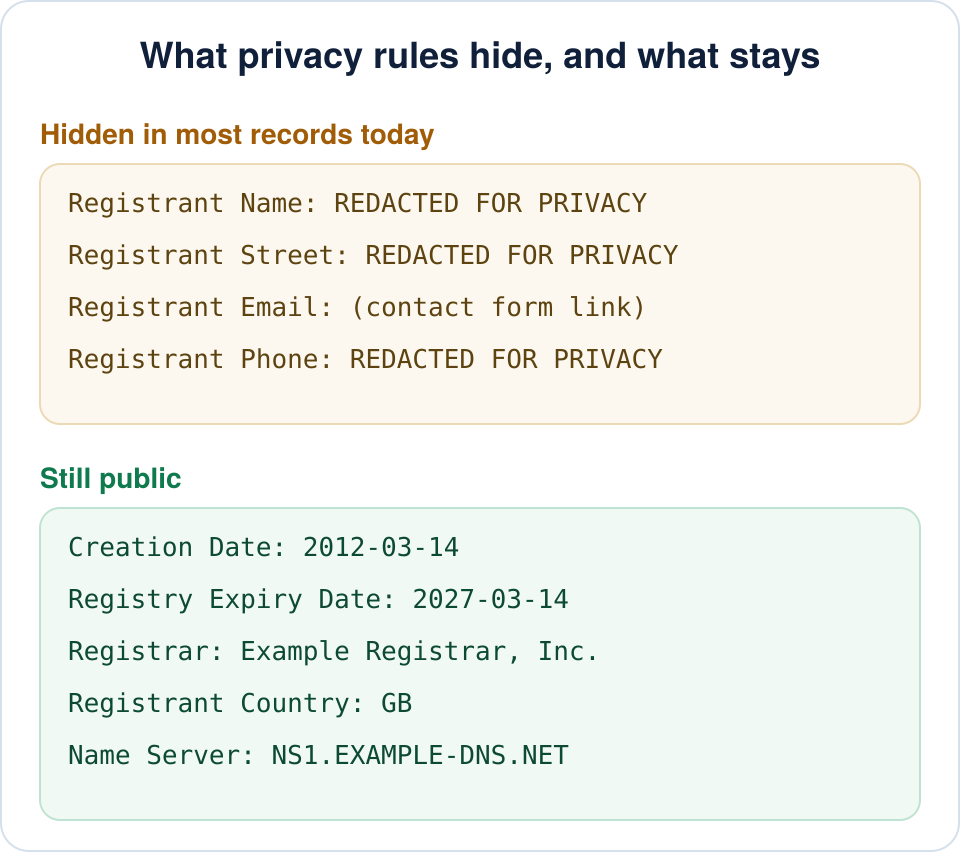
The registrar holds the real details and simply does not publish them. The record shows REDACTED FOR PRIVACY, Data Protected or a similar phrase in place of each personal field. The owner did nothing to obtain this: it is automatic.
A privacy or proxy service
Here the record shows a real name and address, but they belong to an intermediary company whose business is to appear in the record instead of the owner. These services existed long before 2018 and were often sold as an extra. You recognise them by an organisation name containing words such as Privacy, Proxy, Protect or WhoisGuard, and by an address shared with thousands of other domains.
For someone reading the record the effect is the same: you cannot see who the owner is. For the trust score, CheckWhois treats both cases identically.
What is still public
- The creation, update and expiry dates, written by the registry.
- The registrar and its abuse contact.
- The status codes and the name servers.
- Usually the country of the registrant, and often its state or province.
- Often the organisation, when the owner is a company rather than a person. Privacy law protects individuals, not businesses, although many registrars redact both to be safe.
- A way to contact the owner: an anonymised email address or a web form that forwards your message.
The most useful parts of the record for judging a website, the dates above all, are untouched.
Is a hidden owner a warning sign?
On its own, no. It is the situation of the great majority of domains, including those of banks, newspapers and public bodies that leave the default in place. Treating redaction as suspicious would mean suspecting nearly everyone.
This is why the criterion weighs only 8 points out of 100 in the trust score, and why a hidden owner still earns half of them. A published owner is a small plus. A hidden one is not a minus worth worrying about.
What does deserve attention is a shop that hides everywhere at once: no owner in the record, no company name on the site, no address, no phone number, only a contact form. The record being redacted is a rule. The website being anonymous is a decision.
If it is your own domain
Check what your record shows by looking up your own domain. If personal details appear and you would rather they did not, ask your registrar: most offer privacy free of charge and can switch it on in a few minutes. Keep the contact details you gave the registrar accurate all the same. They are what proves the domain is yours if there is ever a dispute, and a registrar may suspend a name whose details turn out to be false.
If you run a business, consider the opposite choice. Publishing your organisation in the record costs nothing and is one more thing a careful customer can verify.
Can hidden details be obtained?
Not by curiosity. Registrars disclose them to courts, to law enforcement and to parties with a legal claim such as trademark holders, case by case. The options open to an ordinary person are listed in how to find out who owns a website.