
Sometimes you need a name: to check a seller, to report a copied text, to make an offer on a domain. The WHOIS record used to answer in one line. It rarely does today, but there are other ways.
1. Look at the WHOIS record
Start with a lookup and open the raw record. If the owner is a company, the Registrant Organization line is often still published even when everything else is redacted. The Registrant Country usually is too. For individuals, expect REDACTED FOR PRIVACY: since 2018, data protection rules have removed personal names, addresses, phone numbers and emails from most public records.
A few country extensions still publish more than the generic ones do, particularly for companies. It costs nothing to check.
2. Read the website itself
Obvious, and often skipped. Look for pages called Terms, Legal notice, Imprint, About or Contact, usually linked at the very bottom. In the European Union and the United Kingdom, a business selling online must identify itself: company name, registered address and a way to reach it. In Germany and Austria this page is called the Impressum and is required for almost every commercial site.
A shop with no company name anywhere is not necessarily a fraud, but you have just learned something important about how accountable it intends to be.
3. Check the company register
If the site gives a company name or number, verify it at the source rather than taking the page at its word. Most countries run a free public register: Companies House in the United Kingdom, the Secretary of State of each state in the US, the national business register in most European countries. Check that the company exists, that it is active, and that its registered activity has something to do with what the site sells. Fraudulent shops regularly borrow the name and number of a real, unrelated company.
4. Use the contact channel in the record
Redacted records are not a dead end. Registrars must offer a way to reach the owner without revealing who it is: an anonymised email address or a web form, shown in the record in place of the real email. Your message is forwarded. The owner is free not to answer, but for a purchase offer or a polite request this is the normal route, and it works more often than people expect.
5. Go through the registrar
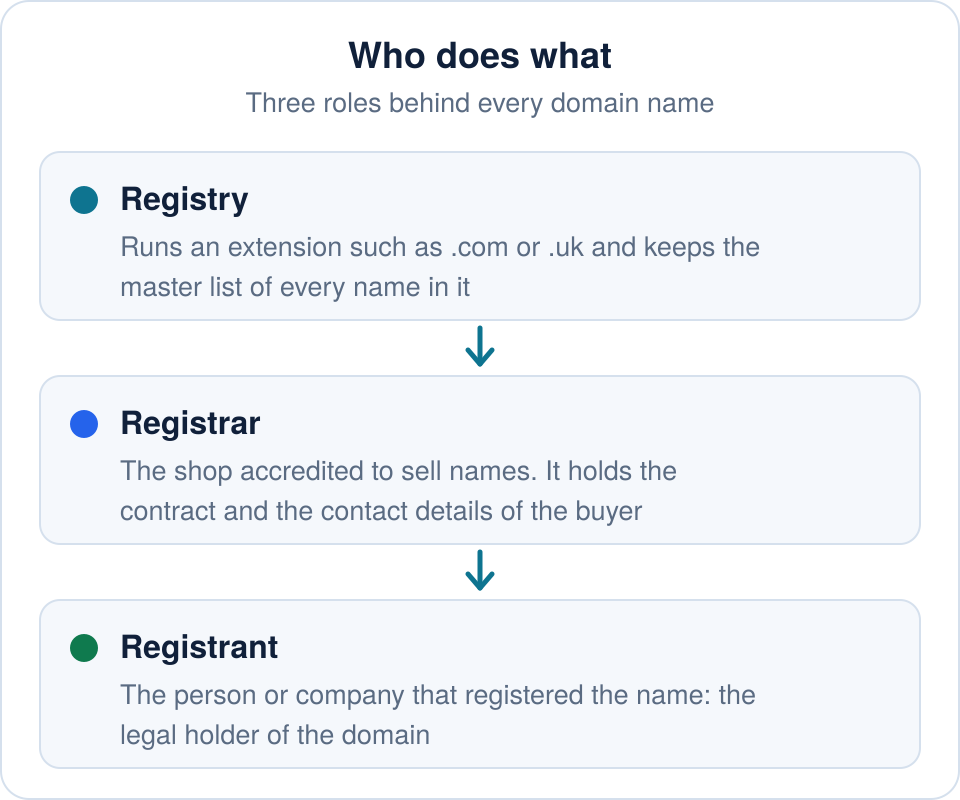
The registrar always knows who its customer is. It will not tell you because you asked, but it has to act in two situations.
- Abuse. If the domain is used for phishing, fraud, malware or counterfeiting, write to the abuse contact given in the record with evidence. You will not get a name, but the domain can be suspended.
- Legitimate legal interest. Trademark holders, lawyers, law enforcement and security researchers can ask for the non-public data. For generic extensions, ICANN runs a Registration Data Request Service that passes such requests to the registrars taking part in it. Each registrar decides whether the law allows disclosure, and the service does not guarantee an answer.
6. When there is a dispute
If someone has registered a domain that copies your trademark, you do not need to know who they are to act. The UDRP procedure, used for .com and most generic extensions, is run by arbitration bodies such as WIPO and can order a domain to be transferred. For anything involving money or damages, a court can order the registrar to disclose the identity of the registrant.
What does not work
Paying a site that promises to reveal hidden owners. The public record is the same for everyone. Services that sell "unmasked WHOIS" either resell old data from before 2018, which may describe a previous owner, or sell nothing at all.
Trusting the IP address. Looking up the IP address of a site tells you who hosts it, typically a large hosting or cloud company with thousands of customers on the same addresses. That is the landlord, not the tenant.
Owner unknown: what it means for trust
Not being able to identify the owner of a domain is normal. Not being able to identify the business behind a shop is a different matter: the first is a privacy rule, the second is a choice made by the seller. When you cannot find out who you are buying from, the other signals carry more weight: how old the domain is, how you are asked to pay, and whether the shop shows the usual signs of a fake.